
Can an AGA heat a whole house?
Looking for a range cooker that will heat the house as well as cook the supper? What an AGA contributes to your home's warmth, what it leaves to the central heating, and where the Rayburn comes in.
A modern AGA will not heat a whole house, but it will do more for the warmth of your home than most people expect. An AGA cooker has a cast-iron body that can be held at temperature all day, radiating steady, gentle warmth into the room it stands in – enough, our customers often tell us, that the radiators in an AGA kitchen rarely need to come on at all – and enough, in the right layout, to be felt in the hallway and the adjacent rooms. But it’s not engineered to replace your central heating, and if you’re looking for whole-house heating from a range cooker, AGA's sister brand Rayburn is built for exactly that. Read on to learn more.
Edwards & Godding is a family business, and we've been working with AGA cookers since 1932, when we became one of AGA's original five distributors. Three generations of our family have worked and lived with these cookers. Our engineers are Gas Safe and OFTEC registered, and service AGA and Rayburn cookers for our customers across Oxfordshire, Berkshire and the South East and South West of England.
Below we'll set out how much warmth an AGA really puts into a house, how far it reaches beyond the kitchen, and what that depends on.
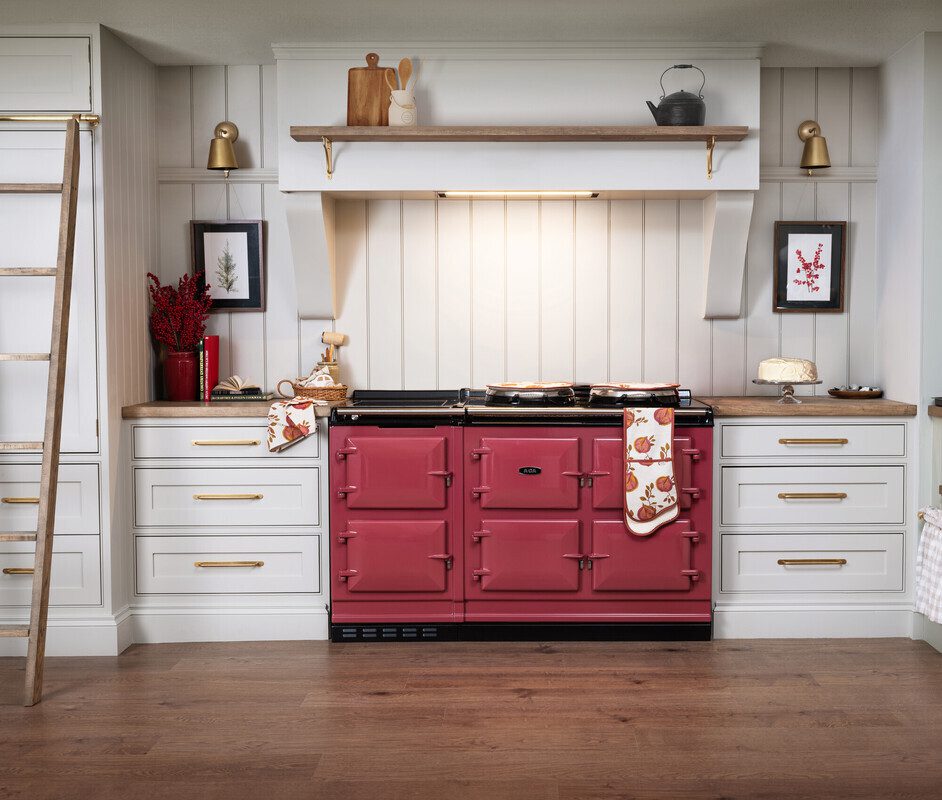
The short answer, from AGA Living
AGA Living explains: “AGA cookers are no longer engineered to run central heating systems.” They go on to say the cookers are designed to stay on, that they give off useful background heat to keep a kitchen cosy, that many models can be switched to an economy setting for gentle warmth without wasting energy, and that if you’re seeking a range cooker that controls central heating too, a Rayburn by AGA may be the perfect appliance for you.
An AGA is a range cooker built around cast iron held at temperature – and cast iron held at temperature radiates warmth back to the room around it. That warmth is one of the real pleasures of living with an AGA cooker, and many owners rely on it. But an AGA is not plumbed in – there's no flow and return, no programmer, no thermostat keeping tabs on the temperature of the rest of your home. The heat radiates from the cooker into the room it's installed in, and from there it radiates as far as the design of your building allows.
Of course, while traditional oil and gas AGA cookers are always on, the modern electric AGA cookers available today are more flexible – you can leave them on all the time like a traditional AGA, or switch elements on and off to suit you.
What an AGA does for your home's warmth
An AGA cooker warms a kitchen in a way nothing else in the house does. Whenever the cooker is on, the cast iron is up to temperature and radiating gently into the room. It isn't the sharp heat of a radiator coming on and going off again. Instead it’s a gentle, constant warmth. On a traditional AGA that's true around the clock. On a modern electric one, it's true whenever you choose.
That old idea of an AGA roaring away day and night, summer included, whether you want it or not, no longer holds. On the AGA Signature (eR7), AGA Compact (eR3) and AGA Mini, every oven and hotplate works independently and can be programmed around your day – on for the morning, off while you're out, on again in time for supper. From slumber the ovens come up to full temperature in ten to fifteen minutes, so leaving the cooker off costs you little in readiness. Through the summer you can switch on only what you're cooking with and keep the kitchen cool, then sink back into that steady warmth when the weather turns. If you'd rather have your AGA always on and always ready – like the traditional gas and oil models – the AGA Classic (formerly the R7) is designed for exactly that. Our guide to traditional vs newer AGA models goes through how the two approaches differ from day to day.
At home, we have an AGA Signature (eR7), which sits on slumber for much of the year. We have single-pane windows in our kitchen – Grade II listed, so they aren't being changed any time soon – and the room is always warm and welcoming. On the bitterest of cold days, we leave the ovens up through the day and turn them back to slumber overnight, and the residual warmth stays.
How far the AGA’s warmth moves through the home comes down to your house. An open-plan ground floor lets the heat move and your dining or sitting area will feel the benefit of the AGA’s warmth. In smaller rooms with the doors shut against draughts, the heat will stay more localised. In spaces with high ceilings, the heat will rise up above head height. A kitchen with three external walls will be cooler than one tucked into the middle of the house, and insulation and glazing determine how much of the AGA’s radiated heat stays in the room. In a compact, well-insulated home the hallway and the adjacent rooms feel it too. In a large farmhouse, the kitchen will be warm, but much of the rest of the house will rely on central heating.
The AGA’s heat has a drying effect as well, which owners of older houses particularly value. It’s great for damp dog walking clothes, and means tea towels can be slung over the rail to dry off quickly rather than sitting damp.
Warmth is just one of the things an AGA gives a house beyond cooking – and we've written about others in seven things you can do with an AGA that don't involve cooking.
What an AGA cannot do – and why
So, an AGA is not designed to heat your whole house. There is nothing inside it to heat water for a radiator circuit and no pipework, it has no thermostat reading the temperature of your hallway or your bedrooms, and it cannot be set to hold the house at twenty degrees the way your heating system can. The warmth it gives a kitchen is not sufficient to heat a whole building.
In an AGA home, the AGA warms the kitchen and the rooms around it, and the central heating covers the rest of the house, though with less demand in the rooms around the kitchen.
If what you’re looking for is a cast-iron cooker that also runs the radiators and the hot water in your home, that cooker exists and it is made by AGA’s sister brand, Rayburn. We compare the two side by side in our guide, AGA vs Rayburn – what are the differences?
Did older AGA cookers have boilers?
Some did, which is why the question comes up so often. Older AGA models could be fitted with a boiler attachment that heated a domestic hot water cylinder – enough for baths and washing up, but never a full central heating system with radiators. Anyone who grew up in a house with one of those remembers the AGA doing more than cooking, and quite reasonably wonders whether today's models still can – but that function isn't part of the range any more.
The tradition didn't disappear, though. It carries on in the Rayburn. You can learn more about the history of the AGA cooker in our article, The story of the AGA kitchen.
For whole-house heating from your range cooker, consider a Rayburn
A Rayburn is a cast-iron range cooker made by AGA's parent company, at the same foundry in Shropshire. It cooks the way an AGA cooks, with gentle radiant heat from cast-iron ovens. The difference is that the central heating models have a boiler built into the cooker itself – it doesn't work alongside a boiler on the utility room wall, it replaces it. That boiler runs a conventional wet system: hot water for the household and, on the larger models, up to twenty radiators. There are cooker-only Rayburns, models that cook and heat your water, and full central heating models, running on oil, HVO, gas or LPG.
If you want a range cooker that also heats your home, a Rayburn is the answer. It is designed and built for the job, and it has been doing so in British houses for three quarters of a century.
We supply and service Rayburn cookers alongside our AGA work. Have a look at the Rayburn range cookers we offer, our Rayburn cookers guide if you'd like the full picture, and what's involved in Rayburn servicing and repairs.
The bottom line – what to expect from an AGA in your home
So how much of your home will an AGA range cooker heat? The answer depends on the house you are putting the cooker in.
In a small, well-insulated cottage with an open-plan ground floor, an AGA makes a real contribution to the warmth of the whole floor. Owners of houses like that often find they use the central heating far less over a winter than they might have expected to.
In a medium-sized period house with reasonable insulation, the kitchen and the rooms opening off it will be warm from breakfast to bedtime with the AGA on and the heating off. Further into the house you'll still want the radiators on, but there is less demand on them downstairs.
In a large period farmhouse with high ceilings and single glazing, a kitchen with an AGA will remain warm, while the rest of the house will need another heating system.
Our guide to AGA running costs puts numbers to the winter figures, and Gas, oil and electric AGA cookers explains how the fuel influences both the cost and the warmth of your home.
If you'd like to know how an AGA might suit your house in particular, do get in touch. Give us a call, drop us an email, or book a free site survey and we'll come and look at the room. Three generations of our family have lived and worked with these cookers, and we'll be happy to share our experience with you.
Frequently asked questions
-
Can an AGA heat a whole house?
-
Does an AGA replace central heating?
-
How much heat does an AGA produce?
-
Did old AGA cookers have a boiler for central heating?
-
Will an AGA heat my kitchen?
-
What is the difference between an AGA and a Rayburn for heating?


