
Rayburn cookers: a complete guide
Everything you need to know about Rayburn cookers – what makes them different from an AGA, how they work, and whether one might be right for your home.
A Rayburn is more than a cooker. Depending on the model, it can heat your home, supply your hot water, and produce beautiful food – all from one cast iron appliance. It's why they've been at the heart of rural kitchens for nearly eighty years, and why people who live with them rarely want to be without one.
If you're considering a Rayburn – whether you're replacing an existing one or exploring the idea for the first time – there's quite a lot to think about, and plenty of choice. Models, fuel options, the installation process itself, and how a Rayburn compares to its more famous sibling, the AGA.
Both cookers are made by AGA Rangemaster. They share a common heritage, and as one of AGA's original five distributors, we've been working with Rayburns for decades. Qualified Rayburn engineers are becoming rarer – the specific experience and qualifications needed to work on these cookers, particularly the oil and gas models, aren't widely held. Stuart, our Rayburn specialist, assesses every Rayburn installation and service we carry out.
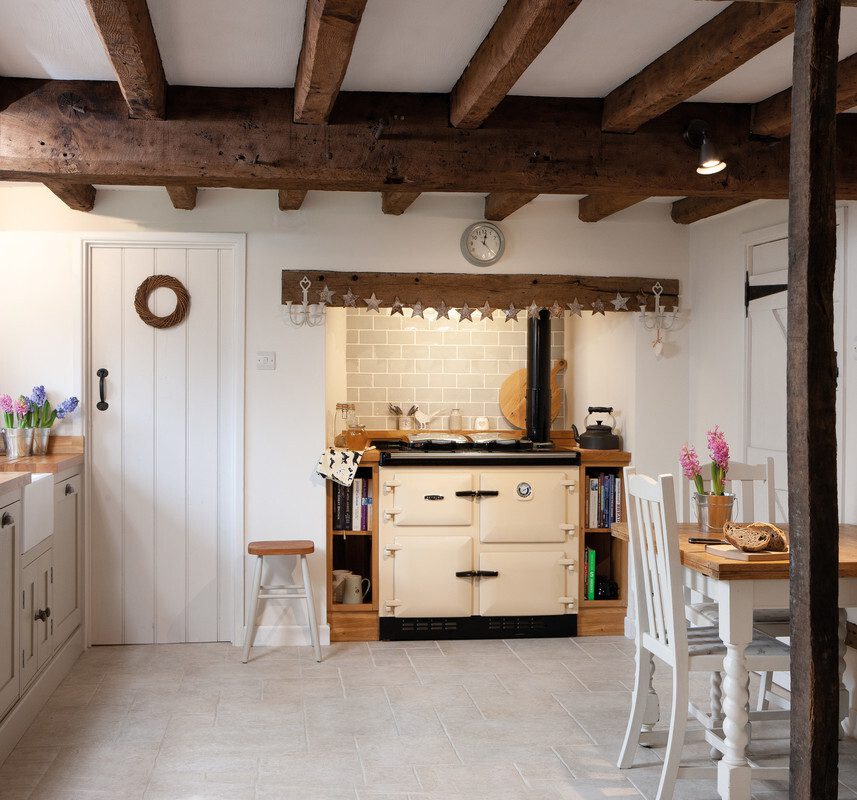
Rayburn and AGA: what's different, what’s the same
The cooking principles across AGA and Rayburn are very similar. Both are cast iron range cookers – enduring British classics – that use radiant heat to produce beautifully moist, even results. The first Rayburn was launched in 1946, nearly two decades after AGA arrived in the UK, and if you've cooked on an AGA, a Rayburn will feel familiar. The iconic enamelled exterior, the dependable warmth, the sense of a cooker that's built to span generations – all of that is shared.
Where the two diverge is in scope. A Rayburn can provide your central heating and hot water as well as cooking, all from a single appliance. That’s particularly useful for rural and off-grid homes where consolidating cooking, heating and hot water into one reliable source makes real practical sense.
There's also a difference in how you control the cooking. With a Rayburn, you can set your oven to a precise temperature and adjust it as you go – an approach that feels immediately familiar to anyone used to a conventional oven or electric AGA. Cooking on a traditional oil and gas AGA is its own thing, and the people who love it wouldn't change it – but the Rayburn's direct temperature control suits cooks who prefer that more conventional relationship with their oven.
Both Rayburns and AGA cookers come in a wide range of models with different oven configurations, so it's less a case of one having more capacity than the other and more about choosing the right model for how you cook and what you need from your appliance. The key distinction remains that a Rayburn can also be your heating system.
Who is a Rayburn for?
Rayburn owners and AGA owners share a lot of the same values – a love of good food, a kitchen that's the heart of the home, an appreciation for something dependable and well-built that will last.
Where the Rayburn customer tends to differ is in what they need from the appliance beyond cooking. Many are in properties where the Rayburn is doing the job of a boiler as well as a cooker – its radiant warmth heating the kitchen and beyond – and that practical versatility is what drew them to it in the first place. But it’s more than that. People who have lived with a Rayburn for years – sometimes decades – simply can't envisage moving away from it. And it's not uncommon for someone to move into a property that already has a Rayburn and find themselves completely won over by the way it cooks, the warmth it gives, the way it becomes the centre of the household.
Some customers choose a Rayburn because they want the traditional setup: oil or gas, a proper flue, a cooker that doesn't rely on the mains electricity supply. Others are drawn to the newer electric Ranger because they grew up with a Rayburn and love the way cast iron cooks, even though their current home is fully electric. There's a model to suit either approach.
The current Rayburn range
There are three categories of Rayburn to choose from, each designed for different needs.
The Heatranger series: cooking, heating and hot water
The Heatranger is the traditional Rayburn – the one Rayburn devotees know and love, and the most popular choice for customers replacing an existing model. These are oil-fired cast iron cookers with large capacity ovens and generous hotplates that can accommodate five or six saucepans at once.
What sets the Heatranger apart is its heating capability. Two independent burners – one for cooking, one for heating and hot water – mean you can control each function separately. The 680 series is the largest, with the biggest cast iron hotplate on the market and a boiler powerful enough to run up to sixteen radiators. It also features thermostatic controls, an integral programmer, and an eco mode that keeps the boiler running at optimum efficiency. The Heatranger 60K, 80K and 100K models offer different boiler outputs to suit different property sizes, with digital displays and electronic controls for independent management of cooking and heating.
Crucially, the current Heatranger models come with HVO-compatible burners. HVO – hydrotreated vegetable oil – is a renewable fuel that can reduce carbon emissions by up to 90% compared to standard kerosene. For eco-conscious buyers in rural areas where oil is the practical fuel choice, this is a meaningful consideration.
The Heatranger is available on oil, LPG or natural gas, with both conventional and balanced flue options on selected models. The enamelled exterior comes in up to sixteen colours, so there's a Heatranger to suit most kitchen schemes.
The Heatranger 300 series: cooking and hot water
The Rayburn 308 is a compact oil-fired model that provides cast iron cooking and hot water, without the central heating element. If you want the Rayburn cooking experience and a constant supply of hot water but don't need to run radiators – or you already have a separate boiler handling your heating – this is a neat solution. A main cooking oven and large warming oven are complemented by a generous hotplate, and the whole unit takes up less space than the larger Heatranger models.
The Ranger: the electric option
The Rayburn Ranger is the newest addition to the family – a fully electric model that requires just two standard 13-amp sockets. No flue, no plinth, no servicing requirements. At 100cm wide, it can slot into an existing kitchen design without any structural changes.
The Ranger has three independently controlled ovens – a radiant roasting oven with grill, a lower oven that switches between baking and simmering modes, and a warming oven. On top, there's a controllable cast iron hotplate and a two-zone induction hob with a bridging feature that creates a larger surface for griddling. It's a cooking-focused model – it doesn't provide central heating or hot water – but for anyone drawn to Rayburn's cast iron cooking without the complexity of a flue and fuel supply, it's a compelling option. Available in eight colours.
A note on fuel
Which fuel you use is generally determined by what's already available at your property. Most Rayburn homes are rural, so oil and LPG are the most common. Occasionally, we find that a customer on LPG needs more heat output than LPG can deliver, and we'll have a conversation about whether switching to oil would better serve their needs. It's the kind of thing that only becomes clear once we've assessed the property properly.
And then there are customers who choose the Ranger precisely because their home is fully electric. Perhaps they grew up with a Rayburn and miss that particular style of cooking – the radiant heat, the cast iron, the way food comes out. The Ranger gives them that without needing to introduce a fuel supply or flue.
What's involved in installing a Rayburn?
If you're replacing a Rayburn with a boiler side, the installation is more involved than a straightforward cooker swap – there are a few more steps than people sometimes expect.
Building regulations have changed over the years, which means flue systems often need updating. If the model has a boiler side, there are additional requirements – bypass systems, pressure release valves, pressure sensing valves – that may not be part of your current setup. These are part of current building regulations, and they're there for good reason.
Stuart carries out a detailed site survey for every Rayburn installation, assessing not just the cooker space but the entire heating system where applicable. Current building regulations require a heat loss calculation for any new heating appliance – working out exactly how much output your home needs, so that the model we install is properly matched to your property. Get this wrong and the Rayburn won't run as it should.
A straightforward replacement typically takes four to five days. That can be a surprise to people who expect something closer to a day or two, but the flue work, heating connections and regulatory compliance take time to do properly.
The Ranger, being fully electric with no flue or heating connections, is a much simpler installation.
Servicing your Rayburn
Oil and gas Rayburns need servicing at least every twelve months. Stuart will check the burners, clean the flue way, inspect baffle plates and seals, and – on gas models – carry out gas tightness tests and spillage tests to make sure all combustion products are being safely drawn up and away through the flue.
This isn't something to let slide. A blocked or partially blocked flue can cause incomplete combustion, which means carbon monoxide finding its way back into your home. On oil models, a neglected service means heavier sooting, reduced efficiency, higher fuel consumption, and ovens that won't reach the temperatures they should. Between services, there's nothing particular you need to do – you know your appliance better than anyone, so if anything seems out of the ordinary, give us a shout.
The Ranger, being fully electric, doesn't require servicing.
If you haven't had your Rayburn serviced recently, or if anything seems out of the ordinary, please get in touch.
Is a Rayburn right for you?
A Rayburn isn't for everyone – and we'll always say if we think it's not the right fit for your home. Stuart recently visited a customer who had a Rayburn in their kitchen and wanted to add a new one in a large barn conversion. The heat output required was simply more than a Rayburn could deliver, and the flue work would have been complex and costly. In that case, a modern electric AGA was the better solution – and that's what we recommended. They're thrilled with it.
Whether you're thinking about a new Rayburn, need to service your existing one, or simply want to talk through whether a Rayburn or an AGA would work best for your home – we're here to help. Stuart and the team can visit your property, assess what's needed, and give you honest, practical advice.
Give us a ring, drop us an email, or visit one of our showrooms. We'll make sure you have everything you need to make the right decision.


