
Gas, oil and electric AGA cookers: what's the difference in how they run?
Learn how an oil, gas and electric AGA differ from each other – to run and to live with, day to day. From a family business working with AGA cookers since 1932.
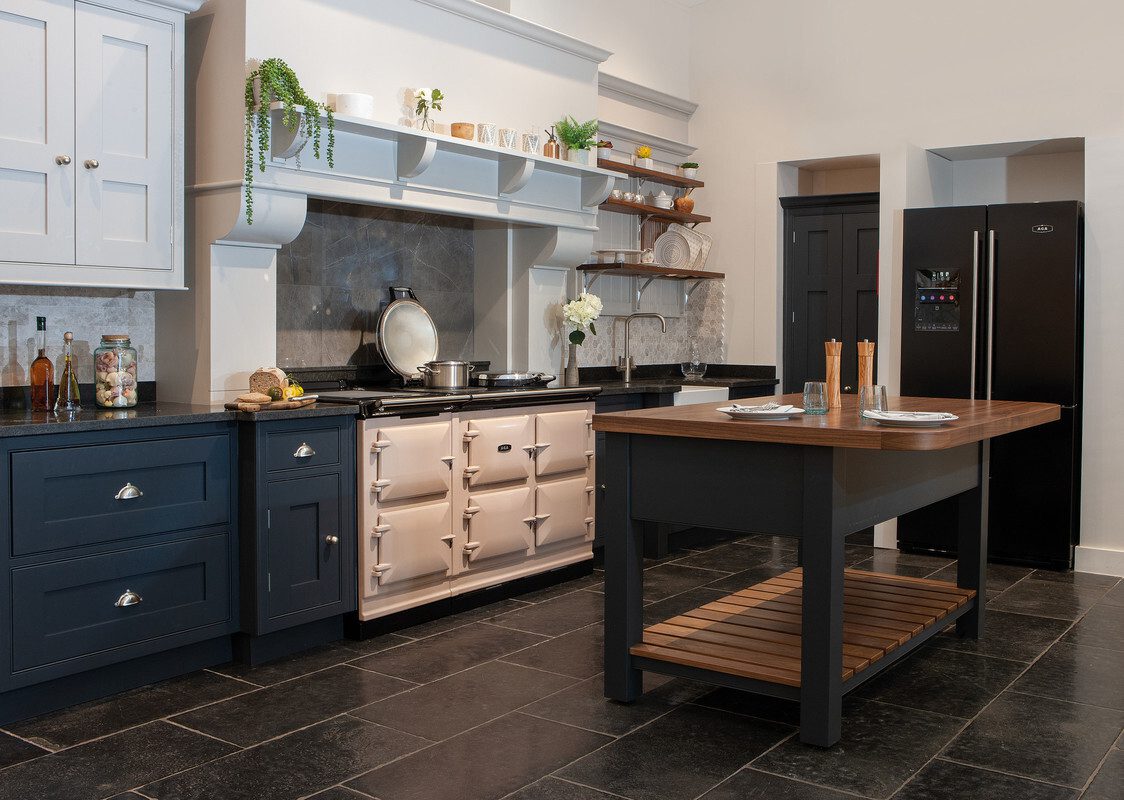
While all new AGA cookers are now electric, thousands of gas and oil models are still going strong in kitchens across the country. If you're thinking of moving from an older model to a new one, you'll likely have questions – chief among them: will it still cook the way your old one does? The answer is a resounding yes. Whatever the fuel, an AGA gives you that same gentle radiant heat, that same beautifully even cooking, that same unmistakable warmth that has a way of making the kitchen the heart of the home. What differs is how the cookers run. Gas and oil AGA cookers are always on, whereas a modern electric AGA needn't be, and its ovens and hotplates can be controlled individually. Then there's how the cooker is installed, how often it needs attention and what it costs to run. In this article we'll take each fuel in turn, from the gas and oil models still in kitchens across the country to the new controllable electric models.
We've worked with these cookers since 1932, when Edwards & Godding became one of AGA's original five distributors. Three generations of the family have cooked on them, installed them and serviced them, and our Gas Safe and OFTEC registered engineers look after all three fuel types for our customers across Oxfordshire, Berkshire, the South East and South West.
How a gas AGA works
A gas AGA is heated by a burner that runs continuously. The cast-iron body of the cooker absorbs that heat and releases it gradually to the ovens and hotplates, and it's this steady, gentle, radiant warmth that lets an AGA cook the way it does. It's a different kind of cooking from a conventional oven – and we’ve written more about this in our article on the difference between a range cooker and an AGA.
The important thing to understand is that a gas AGA is either on or off. Because the whole cast-iron body is held at temperature, the ovens can't be run separately. From cold, a gas AGA takes several hours to come up to temperature, and it should run so that the roasting oven sits at around 220–240°C.
A gas AGA warms the room the whole year round, and in winter that's very welcome. In summer though, the cooker is warm whether you want it to be or not, and short of switching it off entirely there's little you can do to change that. It's the thing gas owners raise with us most often, and one reason many are moving to the new controllable electric models, which offer far more flexibility and can be turned down or switched off when the weather's warm.
A gas AGA needs a flue, so it has to sit against an external wall or in an existing chimney breast. It also requires servicing once a year. This needs to be done when the cooker is cold – so many people opt to do this in the summer. Our Gas Safe registered engineers service gas AGA models of every age across Oxfordshire, Berkshire, the South East and South West, whether or not we supplied them – learn more and book your gas AGA service.
How an oil AGA works
An oil AGA works in much the same way as a gas one. A burner beneath the cast iron runs continuously, fed with kerosene from a tank outside. The ovens heat together, just as they do on a gas model. The differences are in supply and servicing.
With an oil AGA you look after your own fuel supply. The tank sits outside, and topping it up is down to you – watching the gauge, ordering before you run low, and buying at whatever the market price is that week. Oil tends to be cheaper in the summer than during the colder months, when demand is high and deliveries take longer to arrive. Owners who have had an oil AGA for years tend to top up in late summer and keep the tank more than a quarter full.
An oil AGA also puts out a little more heat than a gas one. In winter that's welcome, warming a large kitchen through the coldest months. In summer, many choose to switch their AGA off altogether.
An oil AGA needs to be serviced twice a year rather than once, because the burner and flueways need cleaning more often. This means two visits to arrange rather than one, and is the main reason oil costs more to maintain than gas. Our OFTEC registered engineers handle this for our customers across Oxfordshire, Berkshire, the South East and South West – learn more and book your oil AGA service.
Where there's no mains gas: LPG
LPG (propane) is delivered and stored in a tank, much as oil is, but it burns as mains gas does, so the cooker behaves exactly like a gas AGA. It runs at roughly double the cost of mains gas. LPG is used in rural properties where mains gas isn't available, so in practice it is a question of what can be supplied to the house rather than a choice between fuels. Again, our engineers service LPG models across across Oxfordshire, Berkshire, the South East and South West – learn more and book your LPG AGA service.
How a modern electric AGA works – and why it's different
A modern electric AGA has the same classic look, in that same heavy cast-iron, and cooks with the same radiant heat as a gas or oil model. What it adds is flexibility and control.
Where a gas or oil AGA operates a single body – on or off as a whole – a modern electric one allows you to run each part on its own. Every oven and hotplate on the AGA Signature (eR7) and AGA Compact (eR3), for example, is controlled independently: switch elements on or off as you need, set them by touch screen, drop the whole cooker to a low slumber setting, or put the ovens on a timer so they come on in time for supper and switch themselves off during the day while you’re out of the house. The hotplates reach temperature in eight to ten minutes from cold. The slumber setting holds the cast iron warm at a resting temperature – quick to bring back up, and a fraction of the energy of running it at full heat. Our article on Traditional vs newer electric AGA models covers how the range has changed.
Modern electric AGA cookers also offer things that were never possible with the gas and oil models. Depending on the cooker you choose, you might opt to add an induction hob, a ceramic or gas hob, or a conventional fan oven and grill alongside the cast iron.
None of the newer models needs a flue. Instead, they use internal venting, which means you can place the AGA wherever suits the layout of your kitchen, rather than having the location dictated by the location of an external wall or a chimney breast. No annual servicing is required either.
Electric AGA cookers aren't new in themselves – earlier models ran on a 13-amp supply and stayed on like gas and oil. The AGA Total Control was the first to offer independent control over each oven and hotplate, and today’s models are an evolution of that model. Learn more in our recent article on what happened to AGA Total Control and what replaced it.
Of all of the electric models, the AGA Classic (R7) is the one that’s closest to a traditional oil or gas AGA . It is electric, with no flue and no annual service, but it is designed to be always on, its cast-iron ovens warm and ready whenever you are. The controls are simple: four oven temperatures including a low eco setting, and two cast-iron hotplates. Where the AGA Signature (eR7) gives you full digital control via a state of the art touchscreen, the Classic keeps things familiar and uncomplicated – so if you love the always-ready AGA and don't want to have to manage various settings, the AGA Classic (R7) is likely the model for you.
The day-to-day differences: a practical comparison
Gas | Oil | Modern electric | |
| Always on? | Yes – ovens run together | Yes – ovens run together | No – ovens can be operated independently. (Except the Classic, designed to be run like a traditional oil or gas AGA.) |
| Flue required? | Yes | Yes | No – in-room venting |
| Fuel storage needed? | No (mains gas) | Yes – oil tank required | No |
| Servicing required? | Annual | Twice a year | No annual servicing required |
| Typical weekly running cost | £25-31/week | £24-31/week (oil price dependent) | Classic: £20-25/week. Signature slumber: £14-22/week (or as low as £5 a week in summer, cooking only) |
| Programmable timer? | No | No | Yes (Signature, Compact, Mini) |
| Hob and oven options? | Cast iron only | Cast iron only | Induction, ceramic or gas hob and conventional oven, depending on model |
| Heat-up time from cold? | Several hours | Several hours | Hotplates: 8-10 minutes. Ovens: about 40 minutes |
Running cost figures based on AGA's own test data at Ofgem April 2026 rates. Servicing costs are typical market rates. The 'modern electric' column covers the AGA Signature (eR7), AGA Compact (eR3) and AGA Mini (AGA 60). The AGA Classic (R7) is always-on electric and behaves much like a traditional gas or oil AGA day to day.
In summer, a gas or oil AGA gives out the same amount of heat as it does in January. During the hottest weeks, many owners simply leave the patio doors open. Others switch the AGA off completely for a month or two, cooking outdoors or on a portable hob or air fryer instead. An AGA Signature (eR7), AGA Compact (eR3) or Mini on the other hand can be turned down or switched off altogether, with a hotplate lit for ten minutes when you need one.
And what about turning an AGA off when you go away on holiday? Gas and oil AGA cookers are generally left on when owners go away, because switching one off means coming home to a cold cooker and waiting for a day for it to come back to temperature. The new electric AGA cookers can be switched off and quickly started up again on your return – or even programmed to switch on ahead of your return.
What doesn't change is the cooking. The beautifully succulent roast dinners, the eight-hour shoulder of lamb, that perfect slice of toast: that comes from the cast iron, not from the fuel. Moving from gas or oil to electric changes how the cooker runs, not how it cooks.
Running costs at a glance
Fuel type is the biggest single factor in what an AGA costs across a year. Gas runs at roughly £25-31 a week and oil at £24-31, with oil moving as the market does. LPG is the outlier at around £50-65 a week. Among the electric models, an AGA Classic runs at about £20-25 a week and a Signature in slumber at £14-22 – and because a controllable model responds to how much you use it, a summer spent mostly switched off costs accordingly.
Then there’s the cost of servicing: £289 a year for gas, about £259 twice a year for oil AGA cookers including wicks, and nothing at all for a modern electric model.
For the full breakdown of costs model by model, see our article, How much does an AGA really cost to run?
Running cost figures based on AGA's own test data at Ofgem April 2026 rates. Servicing costs are typical market rates.
Choosing the right AGA for your kitchen
A well-serviced gas or oil AGA will go on for many years. If you cook on it every day and aren’t concerned by the heat during the summer, there is no need to make a change, and an annual or biannual AGA service with a qualified engineer will keep it in tip-top condition.
If you're considering a new electric model, we’ll be happy to help you choose the right model for you. If you want the always-on cooker but not the flue and the annual service, the AGA Classic (R7) is the model to look at. It stays on as a traditional AGA does and has four simple settings and two hotplates – with no flue required, no engineer's visit each year, and lower running costs than either gas or oil. If you want an AGA with increased flexibility and control, consider the AGA Signature (eR7) or AGA Signature Induction. The Signature Induction is the one that we have at home, and after five years we cannot imagine being without it. The AGA Compact eR3) is a shallower version from front to back, for kitchens where a full-depth AGA would sit too far into the room, and the AGA Mini is just 60 cm wide, for kitchens where space is tight.
There is an AGA for every kitchen, and we’ll be very happy to help you find yours. Give us a call, drop us a line or book an appointment and visit one of our showrooms in Woodstock or Reading.
Frequently asked questions
-
Does an AGA need gas to run?
-
What is the difference between a gas and an electric AGA?
-
Can you switch an AGA off?
-
Is an oil AGA the same as a gas AGA?
-
Do modern electric AGA cookers have a flue?
-
Which AGA fuel type is cheapest to run?


