
Preserving on your AGA: jams, chutneys and the summer glut
When the garden gives you more than you can eat.. and why an AGA makes the whole process so much easier and more pleasurable.

At this time of year, gardens and hedgerows are fit to burst. Herbs grow in generous clumps, cherry tomatoes ripen and split on the vine. The apple tree drops fruit onto the lawn – slowly at first, then seemingly all at once. The courgettes, planted in a hopeful row back in the spring, turn to marrows faster than you can eat them.
The time has come then, to chop, to pickle or freeze, to dry the herbs, to make the jams and the chutneys. Of course, the supermarket sells perfectly delicious versions of all these things any day of the year – but that really isn't the point. It's about the pleasure of the task itself, as much as the eating: the satisfaction of catching summer at its peak and preserving it, as households have done for generations.
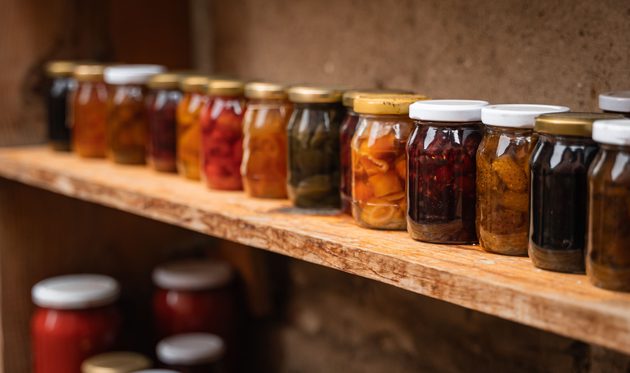
And then your reward. Rows of gleaming, jewel-toned bottles and jars, bunches of dried herbs, a freezer drawer neatly stacked with tubs of stewed fruit to spoon over porridge or yoghurt. Summer's glut, put by for those months when the trees are bare and we've traded sunglasses and SPF for wellies and woolly jumpers.
And doing this in an AGA kitchen is particularly pleasurable, because the AGA makes the whole process so simple. Jam wants a fast, furious boil to reach its setting point; chutney wants hours of low, steady heat to cook down and turn dark and thick. Jars need sterilising, and herbs want a gentle warmth. The AGA has a part suited to each.
Making jam on your AGA
A good jam depends on a fast, hard boil – and the AGA's boiling plate is the perfect thing for the job. The hottest surface in the kitchen, it will bring a pan up to a full boil in minutes, so the fruit keeps its vivid colour and flavour, then holds it there until the jam reaches its setting point of 105°C. Other parts of the cooker do the supporting work: the simmering oven warms the sugar so it dissolves cleanly, and the simmering plate gently softens the fruit before it goes up to the boil. Our favourite recipes include River Cottage's Raspberry Jam and Delia's Gooseberry and Elderflower Preserve.
If you have a surplus of fruit and have made more than enough jam, the simmering oven will stew a panful of plums or apples or chopped rhubarb down to something beautifully soft and spoonable in an hour or so, ready to freeze in portions, to be served with your morning yoghurt or porridge for months to come.
Making chutney on your AGA
Chutney is the perfect way to use up some of those overgrown courgettes, cooking apples and green tomatoes. River Cottage's Glutney recipe is excellent, and one you can easily make your own. The method is forgiving and much the same whichever veg or fruits you have to hand.
An AGA makes light work of this. Where a gas hob has you hovering for several hours, stirring so it doesn't catch, an AGA lets you bring everything to the boil on the boiling plate, then move the pan to the simmering oven’s floor, and leave it – no stirring, nothing catching, and no sharp vinegar smell filling the house.
Pot it in sterilised jars (see below) with plastic-coated screwtop lids and put it somewhere dark to mellow. Made in the summer, it will be at its best in time for Christmas – a lovely gift for friends and neighbours who pop by, and perfect alongside cold cuts and cheese on Boxing Day.
Quick pickles on your AGA
Pickling is the quickest preserving of all, and the boiling plate makes it very straightforward. Pack shallots, beetroot, cucumber or the last of the runner beans into a jar, bring spiced vinegar to a brisk boil on the boiling plate, and pour it over. Within a day or two the vinegar has done its work, and the veg comes out sharp, crisp and bright. Nigel Slater’s quick vegetable pickle recipe is a good place to begin, and can be adapted to whatever treasure your garden provides.
Preserving herbs on your AGA
Drying is the oldest way of preserving a herb, and an AGA offers two easy ways to do it: hang them in the warm air of the kitchen, or dehydrate them gently in the warming oven. Which you choose comes down to the herb.
The tough, woody ones – rosemary, thyme, sage, bay, oregano – are low in moisture and dry slowly and beautifully, holding on to their oils and scent, hung in small bunches somewhere warm and airy. A rail above the AGA is ideal.
Meanwhile, the soft, sappy herbs – basil, mint, parsley, chives, tarragon – hold far more water and will turn mouldy hung up. Instead, lay them on a lined tray to dry in the warming oven. They're ready when the leaves crumble between your fingertips. Pop them in a jar and store them somewhere cool, dry and dark, and they'll hold their flavour for a year or more.
Sterilising jars with your AGA
Sterilising jars and lids on your AGA is simple – wash them, then pop them in the simmering oven, lids alongside, for fifteen minutes or so, until they're bone dry and hot. Fill them while everything's warm, seal, and set them out to cool. Listen for the small pop of each lid drawing down as it seals. Label them with the name and the date, and away into the cupboard they go – until some unremarkable Sunday afternoon in the middle of winter, when they’re opened and a spoonful of what’s inside is a small, bright reminder of warmer days.
__
If you'd like to talk through how an AGA might work for your family, or if you're considering making the change from an old oil or gas model to a newer electric one, we're here to help. Give us a ring, drop us an email, or come and visit one of our showrooms. Three generations of our family have worked with, cooked on and lived around these iconic range cookers, and we'll help you find the one that's right for you.
We've written more about summer with an AGA, and about how we run our AGA through the seasons. And if you're weighing up the investment, our guide to AGA costs is worth a read.


