
AGA vs Rayburn: what are the differences?
An AGA and a Rayburn cook in a similar way, but a Rayburn can heat your home too. How the two compare, from a family business that supplies, installs and services both.
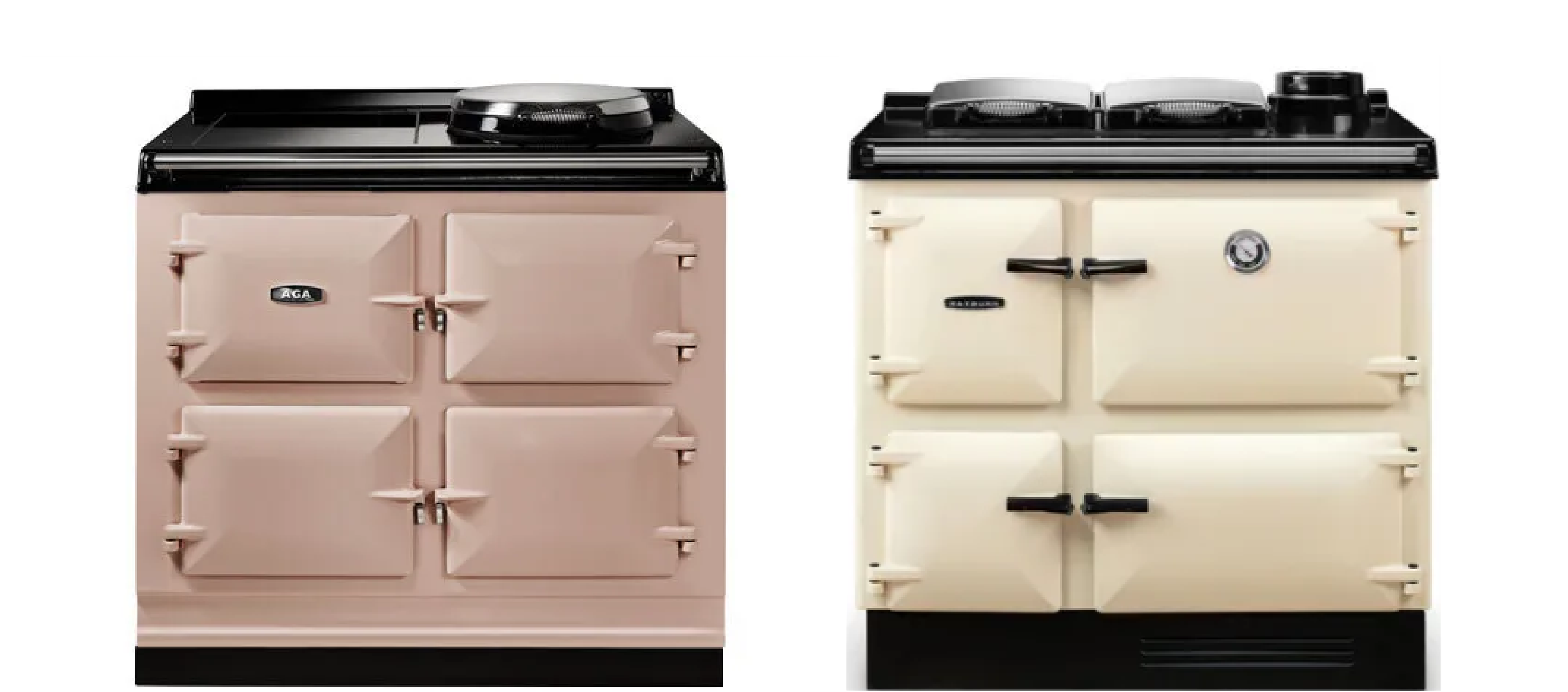
AGA and Rayburn are sister brands, made by AGA Rangemaster in the same factory in Telford, Shropshire, and both cook with gentle radiant heat from cast iron. The main difference between an AGA and a Rayburn is that a Rayburn can heat your home as well. Most Rayburn models provide your hot water, and the central heating models run the radiators throughout the house. An AGA is designed around cooking, with a wider choice of ovens, sizes and colours, and you keep a separate boiler for the heating.
The other difference is in the ovens. A Rayburn has one main oven that you turn up or down to suit the dish, with a lower oven beneath it for warming and slow cooking. An AGA has several cast-iron ovens set at different temperatures, and you choose the right oven for the task at hand.
Edwards & Godding is a third-generation family business. We've worked with AGA cookers since 1932, when we became one of AGA's original five distributors, and with Rayburns since they were invented in 1946. We supply, install and service both to our customers across Oxfordshire, Berkshire, the South East and the South West.
What AGA and Rayburn have in common
An AGA and a Rayburn are both cast-iron heat-storage range cookers. The heat is held in a heavy cast-iron body, and food holds its moisture and its depth of flavour because it's cooked with radiant warmth from all sides of the oven at once.
AGA and Rayburn cookers are finished in the same glossy vitreous enamel. The current Rayburn range comes in sixteen colours, while AGA cookers are available in around twenty, from Cream and Linen to Duck Egg Blue and British Racing Green. And if you can't find quite what you're looking for, AGA will match a bespoke colour of your own.
Both are built to last. Many AGA and Rayburn cookers are still in homes more than 50 years after they were installed. The cast iron doesn't wear out, and parts stay available for older models.
The cooking difference
AGA and Rayburn cook in a similar way, using the same kind of radiant heat – but the ovens work differently, and that shapes how you cook day to day.
With an AGA, each oven is held at a particular heat, so rather than setting a specific temperature for the job at hand, you choose the oven that best suits the task. The roasting oven has a range within it too: the top is fierce enough to brown a joint, while the base will sear a steak in a pan. Once you know your AGA, you stop thinking in numbers and cook by position – this shelf for the potatoes, that oven for the chicken, another to keep the veg just so. Our article on the difference between a range cooker and an AGA explains how AGA cooking works in more detail.
On top of the AGA are cast-iron hotplates for boiling and simmering, under insulated lids. On a cooker that’s left on, both are ready the moment you lift a lid. On a modern electric model you can also programme them to come on when you need them, or heat them from cold in about ten minutes. The simmering plate is the one people use most – an always-ready frying pan, in effect, and with the lid down, a small oven. Learn more in our article, In praise of the AGA simmering plate.
The AGA range also offers far more oven configurations than the Rayburn. The largest AGA Signature (eR7) models have up to seven ovens, and you can add a conventional fan oven and an integral grill alongside the cast-iron ovens on a Signature or an AGA Classic (R7). The AGA Compact (eR3) can be specified with an induction hob and a conventional oven built in.
On a Rayburn, most of the cooking happens in one cast-iron main oven. Rather than moving a dish to a different oven, you turn the main oven up or down to suit it, and use the shelf height to fine-tune the heat. Below the main oven is a cooler lower oven for keeping food warm and for long, slow cooking. The Rayburn 600 Series has the largest main oven in the range, with four heat zones for grilling, roasting, baking and simmering. The electric Rayburn Ranger is the exception, with three separately controlled ovens, including a radiant roasting oven with a grill.
Rather than separate plates, a Rayburn has one large cast-iron hotplate, with hotter and gentler zones across it for boiling and simmering, and you can cook directly on the surface too. The hotplate on the 300 Series takes up to five pans, and the one on the 600 Series up to seven. On the Rayburn Ranger, there's a two-zone induction hob beside the cast-iron hotplate.
The heating difference
An AGA is a cooking range. It warms the kitchen and the rooms around it, and the hot water and radiators run from your boiler. How far an AGA's warmth reaches beyond the kitchen depends on your house, and our guide can an AGA heat a whole house? covers it in detail.
A central heating Rayburn has a boiler built in, connected to your radiators and hot water cylinder in the same way as any other boiler. On the Heatranger and the 600 Series, the cooking and the heating have separate burners, so you can run the heating without the ovens, or cook through the summer with the heating off.
Not every Rayburn heats a house. The oil-fired Rayburn 300 Series provides cooking and hot water without central heating, which suits a home that already has a boiler for the radiators. The Heatranger is the traditional oil-fired Rayburn for cooking, hot water and central heating, with three boiler outputs for different sizes of house. The 400 Series runs on natural gas or LPG, provides hot water and central heating, and is designed to fit alongside standard 600mm kitchen units. The oil-fired 600 Series is the largest, with up to 28kW of output and a boiler that can run up to sixteen radiators. The electric Rayburn Ranger is for cooking only. There's more on each model in our complete guide to Rayburn cookers.
The Heatranger's burners are HVO-ready, so it can run on hydrotreated vegetable oil, a renewable fuel that can cut carbon emissions by up to 90% compared with kerosene. Read more about the benefits of HVO in a Rayburn. Oil and gas Rayburns need servicing once or twice a year, depending on the model, and our guide to Rayburn servicing and repairs explains what's involved.
Fuel types – AGA and Rayburn options compared
Every new AGA cooker is electric. On the AGA Signature (eR7), AGA Compact (eR3) and AGA Mini (AGA 60), each oven and hotplate can be switched on and off on its own, so you can run as much or as little of the cooker as you need. The AGA Classic (R7) is designed to be always on, with four oven temperatures including a low eco setting. A modern electric AGA needs no flue, so it can go into almost any kitchen – we regularly install them in below-street-level kitchens in Bath, Oxford and London.
Gas, oil and LPG AGA cookers are no longer made, but many thousands are still in use, and our Gas Safe and OFTEC registered engineers service them. Our guide to gas, oil and electric AGA cookers covers how each one runs, and there's more on traditional and newer electric AGA models if you're thinking of changing.
The cast-iron Rayburn range runs on oil, HVO, natural gas or LPG. The Heatranger, 300 Series and 600 Series are oil-fired, and the 400 Series runs on gas or LPG. These all need a flue. The Rayburn Ranger is all-electric, needs no flue and runs from two standard 13-amp sockets.
For a rural home off the gas grid, the choice is usually between oil and LPG, and both are available in central heating Rayburn models. Which suits you depends on what's already at the property, and we'll look at that during a site survey. Solid fuel Rayburns aren't part of the current range, though many older wood and coal-burning models are still in use, and we service those too.
Which is right for you?
The table sets out the main differences between AGA and Rayburn cookers side by side.
| AGA | Rayburn | |
| Ovens | Several cast-iron ovens set at different temperatures; up to seven on the largest AGA Signature (eR7) | One main oven and a lower oven on cast-iron models; three ovens on the Rayburn Ranger |
| Oven control | AGA Classic (R7): always on, four oven temperatures including a low eco setting. AGA Signature (eR7), Compact (eR3) and Mini (AGA 60): each oven and hotplate switched on and off and programmed separately | Main oven turned up or down to suit the dish |
| Hotplates | Separate cast-iron boiling and simmering plates | One large cast-iron hotplate with boiling and simmering zones |
| Central heating | Warms the kitchen and nearby rooms; heating from a separate boiler | Heatranger, 400 Series and 600 Series – up to 16 radiators on the 600 Series |
| Hot water | From your boiler | All cast-iron models |
| Fuel (new models) | Electric | Oil, HVO, natural gas or LPG; electric on the Rayburn Ranger |
| Flue required? | No | Yes, except the Rayburn Ranger |
| Colours | Around 20, plus a bespoke colour service | 16 (8 on the Rayburn Ranger), plus a bespoke colour service |
If cooking comes first, and you'd like the widest choice of ovens and configurations, a modern electric AGA is the one to look at. The electric range fits kitchens of every size, from a farmhouse to a city flat. Browse our AGA range cookers.
If you want cast-iron cooking and you also need your cooker to provide your hot water and heat the house, look at the Heatranger, 400 Series or 600 Series, depending on your fuel and how much heat your house needs. If you're off the gas grid, an oil- or HVO-fired Rayburn is the natural fit, and the 400 Series covers LPG. See our Rayburn range cookers.
A new AGA starts at around £7,500 for the smaller models and runs to around £22,300 for the largest Signature models. A new Rayburn starts at £8,350 for the 300 Series, with the Rayburn Ranger from £9,895 and the central heating models from around £11,200 for the Heatranger to around £12,100 for the 400 and 600 Series.
We install Rayburns as well as AGA cookers. Before we fit one, Stuart, our Rayburn specialist, visits the house to work out how much heat it needs and which model is best suited to it. He'll also tell you if a Rayburn isn't the answer. When a customer asked about one for a large barn conversion, the building needed more heat than a Rayburn could deliver, so Stuart recommended a modern electric AGA, with the heating from a separate system – and they’re thrilled with it.
Replacing a Rayburn that already runs the heating usually takes four to five days, because the flue and heating connections need bringing up to current building regulations. Once it's in, our AGA and Rayburn servicing team will look after it for years to come.
__
Whether you're leaning towards an AGA or a Rayburn, we'd be glad to help you find the perfect cooker for your home. Give us a ring, drop us an email, or come and visit one of our showrooms in Woodstock or Reading. When you're ready, we can arrange a free site survey to look at your kitchen, your heating and your fuel supply.
Frequently asked questions
-
What is the main difference between an AGA and a Rayburn?
-
Can a Rayburn replace a boiler?
-
Is a Rayburn better than an AGA for cooking?
-
Do AGA and Rayburn use the same fuel?
-
Do Edwards & Godding sell and service Rayburns?


