Replacing your AGA: what to expect from first call to first cook
How the process works when you buy a new AGA with Edwards & Godding – from choosing the right model to installation day.
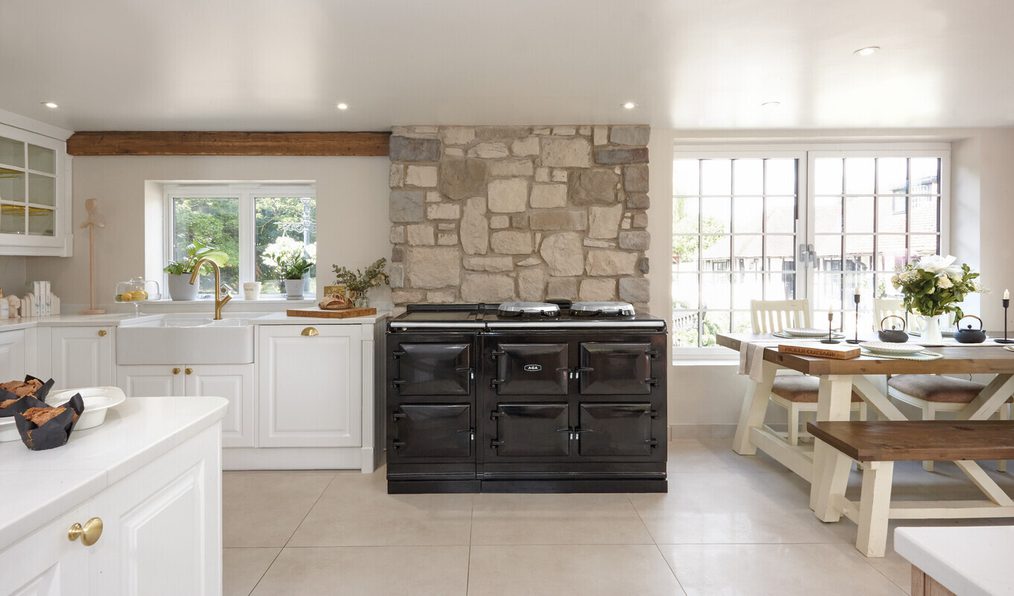
Having a new AGA installed can feel like a big undertaking. There's the cooker to choose, often a concrete plinth to remove, your old cooker to dispose of, sometimes worktops or splashbacks to adjust... It's the kind of project that's easy to keep putting off.
It doesn't need to be that way. At Edwards & Godding, we manage the whole process for you in-house, and most of our customers tell us it was the part of their renovation that ran most smoothly. Here's how it works.
Choosing the right model
Today's AGA range is broad. All new cooker models are electric, but they vary – from compact two-oven cookers that fit a standard 60cm space, to five-oven models with induction zones and individually programmable controls. The right choice depends entirely on how you'll use it.
That's why the first conversation is really about you. Ed is one of our three directors alongside his wife Caroline and brother-in-law, Alex – and heads up all of our servicing and installations. Ed will want to understand your kitchen, your lifestyle, and how you like to cook. From there, he'll recommend the model that fits you – not just your kitchen dimensions.
If you've had an AGA before, we'll want to know what you loved about it and what you'd change. If it's your first, we'll explain how an AGA differs from a conventional cooker – how the simmering oven transforms slow cooking, how the radiant heat changes the way food tastes. We have AGAs in our own homes, so we're speaking from daily experience.
The site survey
Depending on your setup, we may recommend a site survey before installation. Either Ed or Alex will attend your survey personally, and each of them brings decades of experience installing AGAs, and will already be thinking through any potential challenges on your behalf.
They'll measure your space, check finished worktop heights, consider the distance from the wall to account for your splashback, and plan how we'll get the cooker into your kitchen. If access is something you've been worrying about, you might be relieved to know that we regularly deliver AGAs to below-street-level kitchens in Bath, Oxford and London, and through doorways that might at first appear far too narrow to squeeze a cooker through. We have a battery-powered tracked platform called the Zonzini that goes up and down steps. Across the thousands of installations we’ve managed over the years, we can think of only one AGA we haven't been able to deliver.
If you're working with a kitchen designer or builder, we can liaise with them directly – reviewing plans, advising on cabinet positioning relative to where the AGA will sit, and making sure everything is coordinated. Getting these details right at the planning stage is always easier than having to adjust later – particularly things like the relationship between cabinet depth and the front face of the cooker, or making sure finished worktop heights will line up properly with the top of your AGA. But we can make adjustments after the fact too, if that’s required.
Installation day
Every installation is different, and what's involved depends on what's already in your kitchen. Some jobs – particularly where there's no old plinth to deal with – can be done within an afternoon. If your old AGA sits on a concrete plinth (as many traditional models do), we'll need to remove that before the new cooker goes in, which takes a little longer.
Our installation team is entirely in-house – we don't subcontract to anyone. Our engineers are all trained installers, and many have come up through the business over years, building up the kind of knowledge you only get from doing this day after day, year after year. Rather than dust sheets, which in our experience just hold onto dust and release it the moment you move them, we use a large extractor throughout plinth removal work. It keeps things remarkably clean.
It can be very difficult to find tradespeople willing to take on small finishing jobs – a narrow strip of worktop here, an infill panel there. For that reason, our team has the skills and the kit to adjust worktops, fit infill panels, source matching splashback materials, or install a new extractor hood. Ed even has relationships with local fabricators and can often locate small cuts of your existing worktop to save you having to buy a full sheet of granite for the sake of adding a narrow strip. We'll handle whatever's required so that everything looks as though it was designed that way from the start – it’s the attention to detail that makes all the difference.
Removing your old AGA
If you're replacing an existing AGA, we'll remove your old cooker and send it back to AGA to be recycled. The cast iron is melted down and used to make new cookers – so an AGA that's spent twenty or thirty years at the heart of your kitchen goes on to become part of someone else's. We like that.
It's worth mentioning your old cooker when you get in touch, as we often run offers for replacement customers.
How long does the whole process take?
We can work to whatever timeline suits you. We've managed turnarounds of just ten days when the situation called for it, and we've also had customers who ordered their cooker, then came back to us when life allowed – sometimes much later than they'd originally planned. We'll work around your schedule, your renovation, and whatever else is going on.
Ready to take the next step?
If you've been thinking about a new AGA – whether you're replacing an old one or considering your first – we'd love to talk it through. Give us a ring, drop us an email, or book an appointment at one of our showrooms, where Ed will walk you through the options over a cup of tea.
For information about pricing across the range, take a look at our guide: How much is an AGA cooker? And if running costs are on your mind, our guide to AGA running costs in 2026 covers the numbers.