Our family's year with an AGA: from winter warmth to summer cooking
How our family uses the AGA through the seasons – from winter warmth to summer cooking, weekend roasts to weeknight speed dinners.
One of the questions we get asked most often is how an AGA works through the changing seasons. Do you leave it on all the time? What about in summer when you don't want extra heat? How does it fit with family life when everyone's eating at different times?
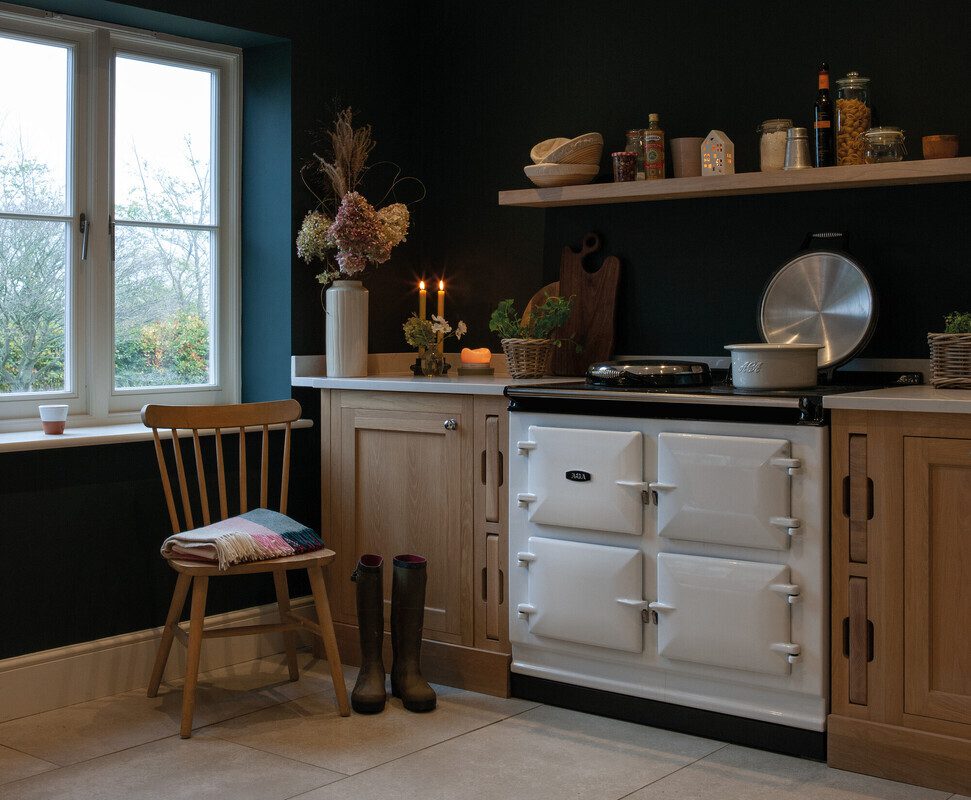
Ed and I have had our AGA Signature (AGA eR7) 150-5i for five years now, and I thought I'd take you through exactly how we use ours as a family, season by season.
Winter: the warm heart of the house
Our AGA tends to sit on slumber most of the year. It's ticking over quietly, building up a gentle warmth that means we never come into a cold kitchen. The first thing we do most mornings is move the dog baskets away from the front of it. Naturally, they’ve claimed the warmest spot in the house!
From slumber, it takes 10 to 15 minutes for the ovens to get up to full temperature when we need them. This flexibility is one of the things I love most about our model – we're not committed to having it blazing away all the time, but we can turn it up quickly when we want to cook.
When it gets very cold – those bitter winter days when the wind cuts through – we'll leave the ovens on full all day to keep the kitchen lovely and warm. We turn them back down to slumber overnight, but that residual warmth stays. Even with our draughty, single-pane windows (Grade II listed, so we're not changing them any time soon), the kitchen is always welcoming.
The hot-cupboard on our AGA is independently controlled from the rest of the cooker, and I keep this on most of the time. It's brilliant for drying tea towels, swim towels and costumes, and Tupperware lids that never seem to quite dry completely in the dish rack. But I also use the warming oven nearly every day.
With three boys – 16, 14 and 11 – who are all busy with school and clubs, it's rare that we're all home at the same time to eat together on a weeknight. The warming oven is a lifesaver. You can keep individual plates warm or an entire casserole sitting happily for a few hours without drying out. No more dried-out pasta or cold shepherd's pie when someone finally gets home from football training.
Winter cooking: slow mornings and weekend feasts
Our family loves porridge for breakfast. I either make it overnight in the warming oven – you just put your oats and milk or water in a pan and leave it to cook gently while you sleep, waking to perfect porridge – or I make it on the induction hob when I'm in a rush.
My middle son is mad about eggs. His favourite is AGA-fried eggs with toast, which are genuinely healthier because you only need the tiniest drizzle of oil. I heat up the simmering plate (takes about 10 minutes), pop on a round piece of Bake-O-Glide, brush with a little oil to stop the egg sticking, crack the eggs onto it and close the lid for 3 minutes. Perfect eggs and great energy for a 14-year-old heading off to school.
Ed does more of the cooking at weekends when he's got the time to enjoy it. He'll go for more involved recipes – things that benefit from having both AGA hotplates on and taking a slower approach. The boys love steak and chips, which Ed does beautifully. There's nothing quite like steak cooked on a griddle or frying pan on the base of the roasting oven, which acts as another boiling plate. It keeps all the steam within the oven, and if your AGA is externally vented, the fan draws it all outside.
At weekends, the boys do more cooking too – there's usually a queue for the simmering plate on Saturday mornings. Pancakes, French toast and toasties can all be done directly onto Bake-O-Glide. It's become our Saturday morning ritual.
The AGA through spring and early summer
As the weather warms up, we keep the AGA on slumber more consistently. It's there when we need it – brilliant for roast chicken on a Sunday or slow-cooking a casserole during the week – but it's not throwing out heat unnecessarily.
The AGA also handles busy weekday cooking. For slow cooking, everything goes into a cast iron casserole and straight into the simmering oven before you leave for work – no need to heat it up on top first. It ticks away nicely all day. The one thing to remember is that you don't lose liquid like you do with conventional ovens, so start with less than you think you need.
For quick cooking – pasta, a stir fry, things that need doing fast – the boiling plate or induction hob work perfectly. You can even put things straight from the freezer into the AGA. We do lasagne, cottage pie and chilli this way. For things like fish fingers and frozen chips, our tip is to use the roasting oven and heat up the baking trays first so the frozen food doesn't drop the temperature too much. R9 on the eR7 is the perfect setting for frozen chips.
Summer: keeping your kitchen comfortable
This is where many people worry. Will an AGA make your kitchen unbearably hot in summer?
We turn our AGA off completely when it gets very warm, usually from June through to mid-September. During these months, we just turn the ovens on and off as needed. From cold, it takes about 40 minutes to get to full temperature, though you can also use the programmer to do this automatically.
This flexibility is the beauty of modern electric AGAs. You're not committed to having it on all the time if you don't want to. In summer, we use it more like a conventional cooker – turning it on when we need it, off when we don't.
I do often leave the hot-cupboard on even in summer, unless it's very, very hot. It's such a handy place to dry things, and it doesn't throw out enough heat to make the kitchen uncomfortable.
If we're away on holiday, we turn the AGA off completely. If we're only away for a weekend in winter, I'd leave it on slumber to keep the chill off the house – there's something rather lovely about coming home to a warm kitchen.
Entertaining: when we use everything
When we have people over, we really make use of having five ovens, two hotplates and the induction. The wonderful thing about the AGA is that it keeps food warm so well. You don't need to panic about getting everything cooked at exactly the same time – you can just potter around, and once things are ready they can go in the warming oven. We also use the slow cooking oven to keep food warm, though not for as long as the warming oven.
And people naturally gravitate to the kitchen when you have an AGA – which means whoever's cooking always has company.
What I've learned over the years
I grew up with an oil AGA, then had a 13amp and a Dual Control myself before getting the eR7 five years ago. Each model has its own character, and the eR7 is different in some lovely ways.
When you first move from a traditional AGA to a model like the Signature (eR7), it takes a few weeks to get used to having more control. There will be a point – usually at the most inconvenient time – when you forget to turn an oven up or set the timer, and dinner will be delayed. You'll curse yourself. But you only do that once.
Of all the AGAs I've cooked on, the Signatre (eR7) is my favourite by far. It makes life so much easier and produces food that's genuinely better – in fact, there’s scientific proof that food cooked in an AGA tastes superior. The way the radiant heat cooks so evenly makes a real difference.
Does an AGA fit your lifestyle?
People sometimes ask whether an AGA would fit their lifestyle. I think an AGA can fit anyone's lifestyle, really. If you want to eat good food, it's the best cooker in the world. There's a model to fit any home and any kitchen.
For our family – busy, with everyone on different schedules, wanting the warmth in winter but not in summer – the AGA eR7 150-5i is perfect. And after five years, I honestly can't imagine our kitchen without it.
If you'd like to talk through how an AGA might work for your family throughout the year, get in touch. Give us a ring, drop us an email, or visit one of our showrooms. We'll walk you through the options and help you make the right decision.