
What’s the difference between a range cooker and an AGA?
What sets an AGA apart from a conventional range cooker: what each is like to cook with, what each one costs, and what it's like to have in your kitchen. From a family business working with AGA cookers since 1932.
An AGA is a range cooker, though that description covers a lot of ground. While a conventional range cooker heats the air inside an oven cavity and holds it at the temperature you've set, an AGA’s heat comes from its heavy cast-iron body – the warmth that radiates from the top, sides, back and floor of the oven at once. It's the reason the ovens have heat settings rather than temperature dials, it’s why pastry crisps on the base of the roasting oven with no blind baking, and it’s why the first thing that comes to mind when most people think of an AGA is that unmistakable gentle warmth that makes a kitchen the heart of the home. In this article, we'll take each type of cooker in turn and look at how they work, what each does best, what they cost to buy and run, and what they are each like to live with.
At Edwards & Godding, we've worked with these cookers since 1932, when we became one of AGA's original five distributors. Three generations of the family have cooked on them, installed them and serviced them for our customers across Oxfordshire, Berkshire, the South East and South West. We sell luxury range cookers from other brands too – Lacanche, Mercury, Gaggenau and Wolf among them – and we've spent decades helping our customers to choose the perfect range cooker for their home kitchen.
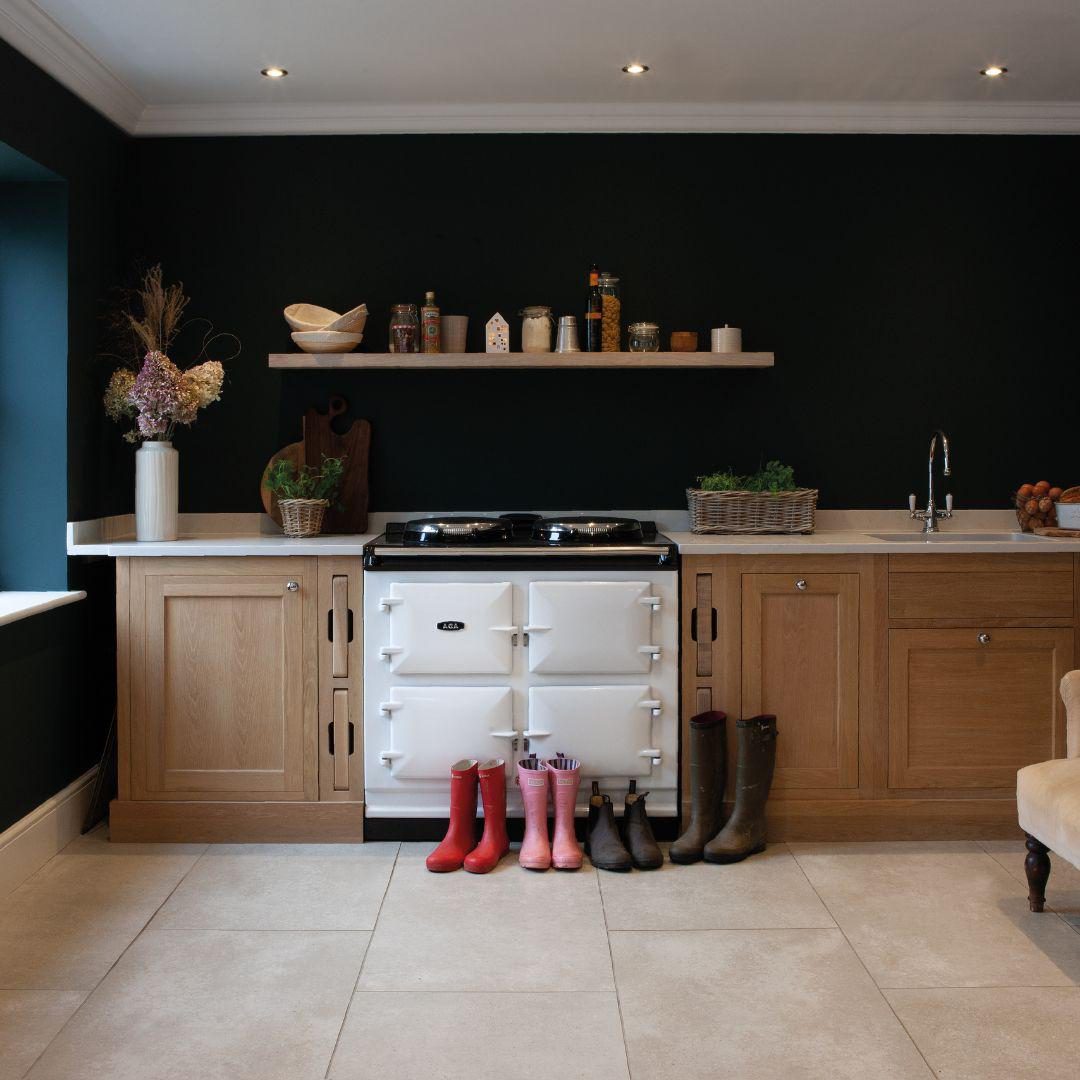
How a conventional range cooker works
A conventional range cooker heats the air inside an oven cavity. An element or a gas burner brings that air up to the temperature you've set, a thermostat holds it there while you cook, and the oven cools again once you switch off. Most models have two or three ovens: usually a fan oven, which circulates the hot air so several shelves cook at the same rate, and a conventional oven where the heat sits in layers, warmer at the top than the bottom. There's a grill, in its own compartment or in the roof of the top oven.
For many cooks the hob is a real attraction: five or six burners or induction zones, each controlled separately, so a flame can be turned right down for a hollandaise on one ring while a pan sits at a rolling boil on the next.
One advantage of a conventional range cooker is precision. If a recipe asks for 165°C, you set 165°C, and once the oven reaches it, it stays there. From cold it might take ten minutes to reach temperature. The rest of the time the cooker is switched off.
How an AGA works, and why it's different
An AGA is a heat-storage cooker. Rather than heating air, it heats a heavy, insulated body of cast iron and holds it at temperature, and the food cooks in the warmth that radiates from every surface of the oven at the same time.
This kind of radiant heat behaves quite differently from hot air. It doesn't dry the air around the food, so moisture stays where it should: a casserole left in the simmering oven all day needs less liquid than it would in a conventional oven, and less attention. A quiche goes straight onto the base of the roasting oven with no blind baking required, the heat coming up through the cast iron crisping the pastry underneath to perfection.
With an AGA, each oven is held at a particular heat, so rather than setting a specific temperature for the job at hand, you choose the oven that best suits the task. The roasting oven has a range within it too: the top is fierce enough to brown a joint, while the base will sear a steak in a pan. Once you know your AGA, you stop thinking in numbers and cook by position – this shelf for the potatoes, that oven for the chicken, another to keep the veg just so.
On top of the AGA sit cast-iron hotplates for boiling and simmering, under insulated lids. On a cooker that's left on, both are ready the moment you lift a lid; on a modern electric model they can be programmed to be hot when you are, or they heat from cold in ten to fifteen minutes. The simmering plate is the one people use most – an always-ready frying pan, in effect, and with the lid down, a small oven. Learn more in our article, In praise of the AGA simmering plate.
Is an AGA always on?
The old idea that an AGA is always on day and night, summer included, no longer holds. New AGA cookers are all electric, putting you in charge of which elements are on or off, and when.
On the AGA Signature (eR7), AGA Compact (eR3) and AGA Mini (AGA 60), every oven and hotplate works independently and can be programmed, so the ovens can be on for supper and off throughout the day. The AGA Classic (R7) stays closer to the original – it is designed to be always on, with four oven temperatures to choose from including a low eco setting, and hotplates which are operated independently. Traditional oil and gas models on the other hand heat the whole body from one burner, so the ovens can't be run separately. These models are no longer made, but many thousands remain in use, and our Gas Safe and OFTEC registered engineers service AGA models of every age across Oxfordshire, Berkshire, the South East and South West. There's more in our guide to gas, oil and electric AGA cookers.
The difference between cooking with an AGA and a conventional cooker
Let's start with slow cooking in an AGA. A pork shoulder goes into a cast-iron casserole in the simmering oven in the morning, and by supper it's tender enough to pull apart with a fork. Chutney – on a gas hob you'd stand over it for three hours; with an AGA you start it on the boiling plate, move the pan to the floor of the simmering oven and leave it to cook down and darken, with no stirring required. When it comes to roasting, the radiant heat browns the outside of your joint without pulling moisture from the middle. Bread and pastry do particularly well in an AGA, and since the ovens are already hot, you can decide to bake at ten and have biscuits ready in time for elevenses.
Meanwhile, a conventional range cooker is hard to beat on those occasions when a recipe demands an exact temperature: precision baking, sugar work, tempering, anything where a recipe says 165°C and means exactly 165°C.
A conventional oven grills under an element, and it’s ready to do so quickly. An AGA grills in the roasting oven – at the top of the cavity, close to the heat for fast grilling, or lower down if you need a more gentle heat. Or you can choose to add an integral grill to your model.
Cooking on an AGA does involve a learning curve, but the knowledge comes quickly, and once it does you won't look back. For anyone moving to a modern electric AGA, the main adjustment is remembering to turn the ovens up before you need them. Our guide to basic cooking on the AGA covers those first weeks.
Living with each, day to day
A conventional range cooker only warms the space around it while it's on and cooking.
A traditional AGA or a modern electric model left on holds the kitchen warm all day: the kettle sits on the simmering plate, so a cup of tea is the work of a moment. Damp tea towels dry quickly on the rail. The warming oven keeps food warm for hours without drying out. No more dried-out pasta or cold shepherd's pie when someone finally gets home from football training.
And of course, an always-on AGA has a way of drawing everyone to the kitchen – it's one of the reasons that so many people who grew up with an AGA at home aspire to have one in their own kitchen.
On the other hand, with the Signature, Compact and Mini, you choose how you’d prefer to run it, day by day and season by season: perhaps like us, you’ll choose to programme the ovens to come on early, before you wake in winter, and switch them off entirely through the hottest weeks of summer. Read more about how we run our AGA through the year.
What each costs to buy, run and keep
Conventional range cookers start at a few hundred pounds, with the premium brands we stock beginning from roughly £3,000.
A new AGA starts at £7,500 for the smaller models and runs to around £22,300 for the largest Signature models. You can read more in our guide to how much an AGA costs. As a long standing AGA dealer and one of the original five distributors, we’re able to offer a great trade-in deal and run promotions throughout the year, so do get in touch for our best price.
AGA running costs have changed considerably with the electric models. At the OFGEM July 2026 rate, using AGA's own test data, an AGA Signature (eR7) costs around £14 a week in economy mode, and an AGA Classic (R7) that’s always on is nearer £27. Our article on how much an AGA really costs to run breaks it down by model and fuel. A conventional range cooker costs less, since it only draws power while you cook.
When it comes to installation, a modern electric model needs no flue, and access is rarely the obstacle people expect: we regularly deliver into below-street-level kitchens in Bath, Oxford and London, and we can adjust your cabinetry if needed.
Then there's the question of how long each lasts. AGA puts the life of its cookers in decades rather than years, and there are many still in homes more than 50 years after they were installed – the cast iron doesn't wear out, and parts stay available for older models. A conventional range cooker is generally replaced within a decade or two.
Choosing between them
If you like to cook to precise temperatures, a conventional range cooker might be the right option for you. Our guide to choosing a conventional range cooker is a great place to start, or get in touch and we'll be glad to help you choose one.
If you’re looking at an AGA, the choice is mainly between a cooker that's designed to be always on – that’s the AGA Classic (R7); and one you control: the AGA Signature (eR7) or AGA Compact (eR3). Our AGA buying guide runs through the collections, model by model.
Better still, book an appointment and come and visit one of our showrooms where you can see AGA cookers and luxury range cookers side by side. We’ll be more than happy to help you find the right range cooker for your home.
Frequently asked questions
-
Is an AGA a type of range cooker?
-
What does an AGA do that a range cooker cannot?
-
What can a range cooker do that an AGA cannot?
-
How long does an AGA last compared with a range cooker?
-
Can I have both an AGA and a conventional oven?


