
Does an AGA add value to a house?
A clear answer – from a third-generation family business that has been living with, selling and installing AGAs since 1932.
Does an AGA add value to a house? The simple answer is that an AGA cooker makes a home more desirable to buyers, which often brings stronger interest, and which can lift the sale price and lead to a faster sale. The exact monetary value it adds to a house price, however, is difficult to quantify. That figure depends on a variety of factors including how the AGA is presented in the kitchen, and the home itself.
As a third-generation family business and an authorised AGA dealer – one of AGA's original five distributors – we've been working with these cookers since 1932. We've installed countless AGA cookers in homes across Berkshire, Oxfordshire and the surrounding counties. This guide draws on our experience, and on the available evidence, to cover where an AGA cooker adds the most value to a home, how to present one so that it adds as much value as possible, and the information sellers and buyers each need to know.
What the evidence says – does an AGA add value?
Currently, there is not a great deal of hard data on an AGA cooker's effect on property value. What exists, though, is encouraging. The most-cited professional view comes from Annabel Morbey of Smiths Gore – now part of Savills – who stated in The Times that an AGA can add up to £10,000 to a property's value, with newer and larger models commanding the greatest uplift. This chimes with our own experience: a well-chosen AGA, cared for and nicely presented, reads straight away to buyers as an asset.
Buyer sentiment indicates the same. In a survey of 2,100 UK adults by SellingUp and Populus, 38% of respondents said an AGA made a house more desirable, with only 13% saying the opposite – a net desirability score of +25, putting the AGA on a par with a home gym. The study is a few years old now, but it surfaced another interesting fact: 32% of over-65s and 40% of 18–24 year olds found an AGA desirable. Clearly, an AGA cooker is attractive not just to older generations but to younger buyers too.
What none of this provides, though, is a precise figure. The true value an AGA cooker adds to a house depends on a number of factors, including the home itself, the kitchen and the market you're selling into. But what is clear from the numbers and from the opinions of professionals is that an AGA is a desirable asset to a home, and that desirability can result in a better price and a faster, more committed sale.
Where an AGA adds the most value
An AGA cooker adds the most value when it is in the right property for the right buyer. Rural and semi-rural homes, period farmhouses and cottages, and family homes built around a generous kitchen – the natural setting for a larger model like the AGA Signature (eR7) – are where buyers most expect to find one. Premium country property listings, ranging from around £600,000 to £1.95 million, including those regularly featured in Country Life, consistently include AGA kitchens among their headline features. Premium new-build homes with design-focussed kitchens belong on this list too: here, a model like the AGA eRA marks out a home created for family life. In all these settings an AGA isn't an extra; it's part of the character of the house.
The one caution we would make is to consider your kitchen’s proportions. In a kitchen too constrained for an AGA to sit naturally, squeezing one in won't do the room, or a future sale, any favours. That isn’t a common issue though, because the range runs well beyond large models including the AGA Compact (eR3 90-3i) at 900mm wide, and the AGA Mini (AGA 60), at just 600mm wide.
AGA kitchens and buyer psychology: so much more than a cooker
An AGA offers something to buyers that few other appliances can: it makes the kitchen the heart of the home. People naturally gravitate towards a kitchen with an AGA in it – there's something about its steady warmth that pulls everyone close. A buyer standing in an AGA kitchen is weighing up more than the space; they're imagining the life they'd lead there – the first coffee of the day in a kitchen that's already warm, roast dinners on a Sunday with the family gathered round. With an AGA cooker, they're not buying an appliance so much as a way of living, and that's what makes the kitchen, and the house, desirable.
That appeal carries straight into the listing’s photography. An AGA cooker gives a kitchen a natural focal point – a warm, characterful centrepiece that makes the room look loved – so the kitchen shot is often one of the strongest in a listing, and one of the first to catch a buyer's eye. And it brings a particular kind of buyer: often someone who already knows they want an AGA in their new kitchen. One buyer who arrives keen is more valuable than a whole crowd of lukewarm ones – they are considerably less likely to drift away mid-sale and tend to want to move quickly. It's the difference between someone who is curious about a house and someone who already sees themselves living in it.
AGA colour and presentation in a kitchen
Presentation is key. A well-presented AGA in a beautifully designed kitchen will doubtless add to a home's value. The same AGA in a tired, tatty kitchen holds less appeal.
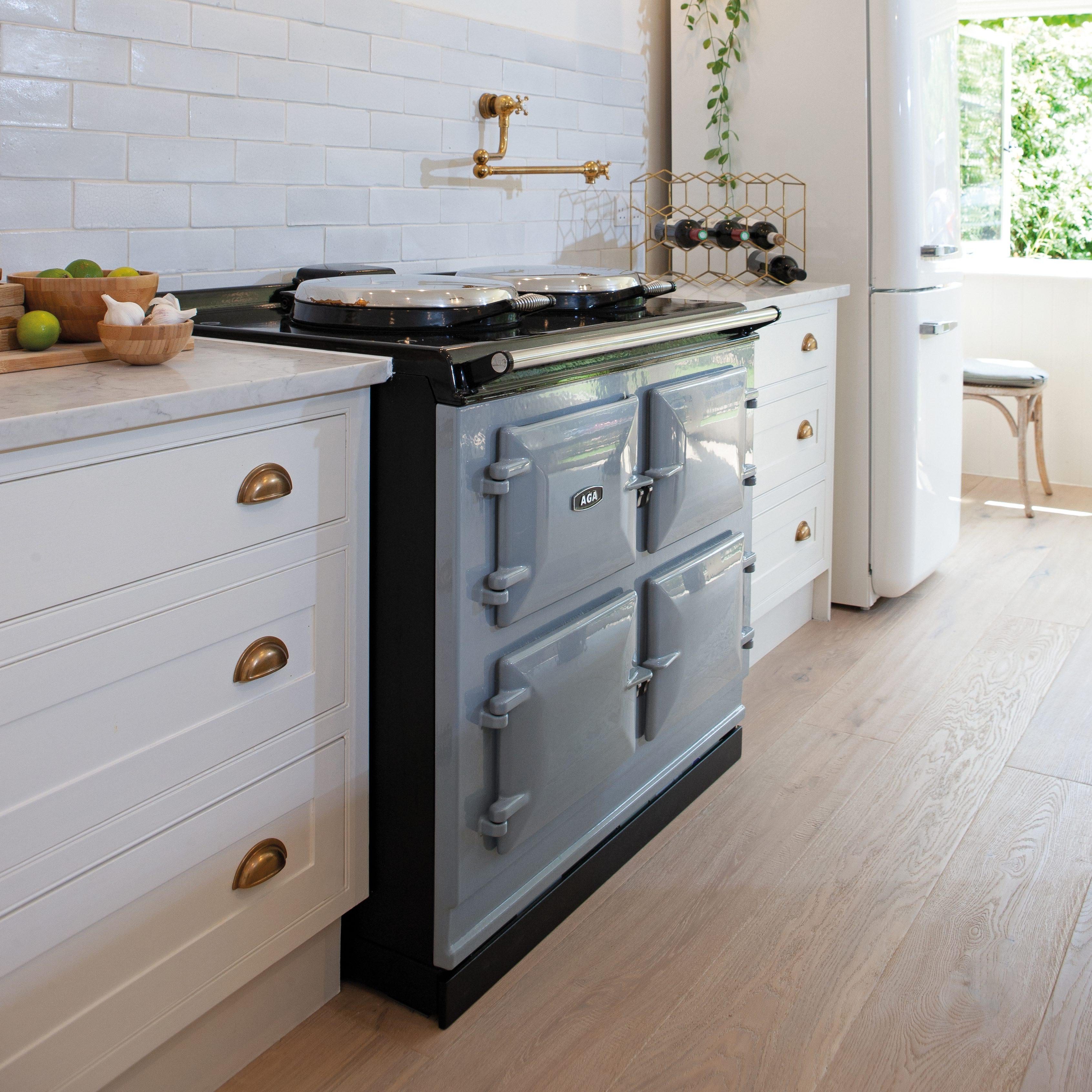
Colour is a key consideration. Choosing the right AGA colour for your kitchen – a shade that sits cohesively alongside your cabinetry, flooring and worktops – draws the whole room together. AGA cookers are finished in a glossy, reflective vitreous enamel that picks up the light and the tones around it, so the AGA reads as part of the room, rather than an object placed in it. An AGA in Cream or Linen next to oak cabinetry, for example, reflects the warm tones that surround it. Get this right and the kitchen reads as one considered, harmonious whole – exactly the kind of thing a buyer responds to. We've gathered more thoughts on this topic in our guide to choosing the perfect colours for your kitchen.
Getting the installation right: plinths, alcoves and kitchen alterations
Another thing that shapes the impression an AGA makes in a kitchen is how the cooker is fitted. A well-installed AGA set into a purpose-built alcove, on a correctly specified plinth, with cabinetry sitting flush around it, has a sense of rightness and belonging. That's the look buyers fall for. An AGA is deeper than a standard cooker, so the surrounding kitchen usually needs adapting somewhat to receive it properly – and when that's done well, the result feels permanent and intentional. Learn more in our article on how to alter your kitchen to fit your AGA.
This is something we take care of as a matter of course. We remove old concrete AGA plinths, level floors, adjust cabinetry and work around the quirks of older properties, so the finished kitchen looks perfectly complete. It's detailed work, but a buyer feels the difference.
The combination that commands a premium: hand-painted kitchens with an AGA
There's one pairing buyers respond to above almost any other: a bespoke hand-painted kitchen with an AGA at its heart. It's a combination estate agents recognise and photographers seek to make the most of. The kitchen and cooker speak to the same values: both are made with real craftsmanship and built to last. Together they signal to a buyer that this is a home put together with care – not assembled off the shelf.
It’s the sense of character buyers are drawn to, and willing to pay for. We’ve written further on the benefits of choosing a hand-painted kitchen, and the article is well worth a read if you’re thinking about the room as a whole.
What sellers should know: presenting an AGA property for sale
If you're selling a house, a complete, warm, working kitchen with an AGA cooker at its centre is a real asset and exactly the kind of thing that will draw a buyer in. Most sellers leave theirs in place for viewings and photographs, and that's by far the strongest position: buyers respond to a kitchen that feels ready to live in.
Of course you can take an AGA with you when you move. If that's your plan, just let your agent know, and make sure it's clear in the fixtures and fittings. We can remove and reinstall the cooker for you – simply get in touch.
Beyond that, make sure your AGA is clean and that you have an up-to-date service record to hand. A well-maintained AGA reassures a buyer in much the way a full service history reassures someone buying a car. Present the kitchen around it with care, and use a photographer who has experience shooting AGA kitchens. Last but not least, price the house for the buyer who wants what you're offering, rather than trying to appeal to a broad market.
What buyers should know: buying a property with an AGA already installed
Buying a house with an AGA already installed is a lovely position to be in. Be sure to ask about the cooker’s servicing history and check it's in full working order. Find out the model and roughly how old it is, and which fuel it runs on – gas, oil or electric. Read about AGA running costs for different fuel types.
We're happy to inspect and service any AGA – of any age, fuel or model. We’ll be able to tell you within a short visit exactly what condition the AGA is in and what, if anything, it needs, so you can buy with confidence.
The bottom line: is an AGA a good investment?
So, does an AGA cooker add value to a house? The evidence suggests so. It makes a home more desirable and it draws committed buyers. Committed buyers tend to mean a quicker sale, and often a stronger price. Present the AGA in a well-appointed kitchen, and it’s a real selling point.
The things that will make a buyer want your kitchen are the same things you'll have loved about it for years – the pleasure of cooking there, the way people are drawn to gather in the AGA’s gentle warmth. An AGA, then, is less a cost than an investment: in how a home feels to live in now, and in how it sells when the time comes.
If you're weighing it up, it's worth reading our articles on whether an AGA is worth buying, and our piece on how much an AGA costs, which between them cover the financial side of the decision.
Frequently asked questions
Does an AGA add value to a house?
The evidence suggests so, particularly in the right property and market. Annabel Morbey of Smiths Gore – now part of Savills – stated in The Times that an AGA can add up to £10,000 to a property's value, with newer and larger models commanding the greater uplift. A survey of 2,100 UK adults by SellingUp and Populus found that 38% said an AGA made a house more desirable, against only 13% who didn't – a net desirability score of +25, on a par with a home gym. The effect is strongest in rural, period and country homes, where an AGA is part of what buyers are looking for. If you're weighing up the decision more broadly, read more about why your kitchen needs an AGA in our recent article.
How much value does an AGA add to a property?
The specific figure will depend on the home, the buyer and how well the AGA is presented. The most-cited professional estimate comes from Annabel Morbey of Smiths Gore – now part of Savills – who stated in The Times that an AGA can add up to £10,000 to a property's value, with newer and larger models commanding the greater uplift. In our experience installing AGAs across Berkshire and Oxfordshire since 1932, the more useful way to think about it is buyer attraction: an AGA reliably draws committed, motivated buyers. For more on the cost of an AGA, read our guide to AGA prices.
What type of property benefits most from an AGA?
An AGA adds desirability to any home, but it does the most for a sale where buyers most expect to find one – rural and semi-rural homes, period farmhouses and cottages, and family homes built around a generous kitchen. In that kind of property an AGA is a headline feature – the sort of thing premium country listings lead with, and part of the character a buyer is paying for.
Does an AGA's colour affect the value it adds?
Indirectly, yes. A colour that works with the cabinetry, flooring and worktops makes the whole kitchen feel considered, and a considered kitchen is what buyers respond to. Neutrals like Cream and Linen have the broadest appeal; characterful shades like British Racing Green or Salcombe Blue can be stunning in the right room. Learn more in our article, Choosing the perfect AGA colour for your kitchen.
What should I check when buying a house with an AGA?
Check the model and age, the fuel type and whether it suits the property, the servicing history, and that it's in working order. Older oil and gas models in particular benefit from regular servicing, while modern electric models are very straightforward to live with. If you're at all unsure about the condition of an AGA in a house you're buying, we can inspect and service any model. Learn more about AGA servicing.
Can an AGA help a house sell faster?
Often, yes. An AGA tends to attract buyers who already know they want one and are looking specifically for a home that has one. That kind of buyer arrives with an emotional connection half-formed, which usually means quicker, more committed interest – and someone who can already picture their life in your kitchen rarely takes long to make up their mind.
Is it worth installing an AGA before selling a house?
It depends on the home, the local market and your timescale. Installing an AGA purely to lift a sale price is a different calculation from installing one to use and love – if you're selling within months, the cost may not be recouped except in the strongest AGA markets. But if you're staying put for a few years yet, an AGA is best understood as an investment in how you live, with resale appeal as a welcome bonus. And since you also have the option to take it with you when you eventually move, the investment isn't tied to the house at all.
____
Whether you're buying, selling, or simply thinking about bringing an AGA into your own kitchen, we're glad to talk it through. Get in touch or book an appointment at our showrooms in Reading or Woodstock, and we'll help you find the AGA that's right for your home.


